
Educational blog post
In the last article, we looked into harmful pathogens and how they can be transmitted to people and cause infectious diseases. We understand that most of the negative effects healthwise can be avoided by keeping good hand hygiene and in more complex situations like COVID-19, we can additionally wear a mask to protect others and follow rules of social distancing. In this article, we can dig deeper into the transmission routes to understand better how to keep ourselves safe from harmful pathogens.
As we know, pathogens’ transmission routes differ. Understanding them in more detail can help plan a better infection prevention program.
Direct contact and droplet spread transmission:
Direct contact transmission is specific:
- Contact with large droplets spread from sneezes and coughs
- Skin-to-skin contact
- Contact with soil or plants harboring hosting harmful pathogens and developing infectious organisms
EXAMPLE:
- Pertussis (whooping cough)
- Hookworm spread by direct contact with contaminated soil
Surface transmission:
Surface transmission is when it all happens indirectly. Surface transmission can be through food or water or through inanimate objects (e.g. mobile phones, door handles, computer keyboards, credit card terminals etc.)
EXAMPLE:
- Food or water contaminated with Hepatitis A
- Improperly canned foods supporting the growth of Clostridium botulinum
Airborne transmission:
It takes place when pathogens are transported by tiny droplets that can actually stay in the air for longer than we care to imagine. Airborne transmission may occur through:
- Dust suspended in the air by air currents
- Droplet nuclei that remain suspended in the air for minutes to hours
EXAMPLE:
- Measles virus that remains in the air several hours after the infected patient leaves the room
See full chart below for modes of transportation.
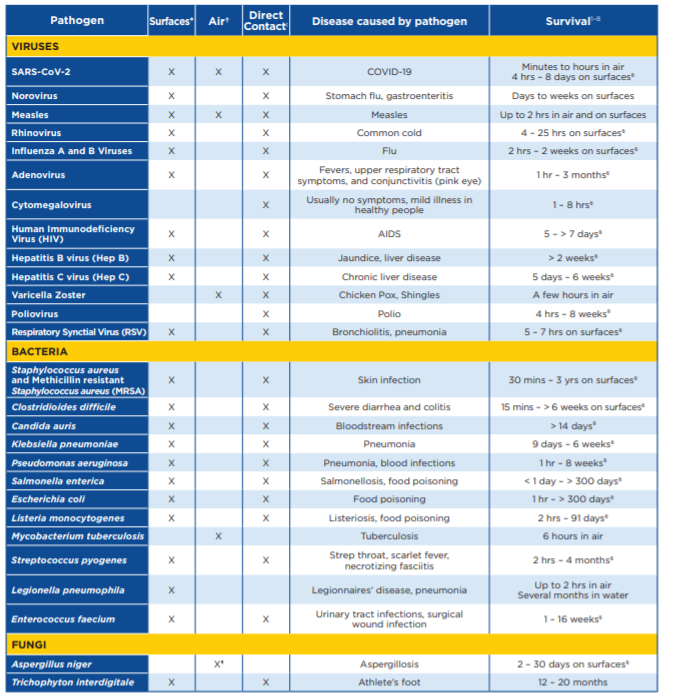
- Refers to vehicle transmission including food, water, and fomites (surfaces) † Refers to smaller airborne droplets that may linger in the air for longer periods ‡ Refers to skin-to-skin
contact, kissing, sexual intercourse or large respiratory droplet transmission § On hard, nonporous surfaces ¶ Aspergillus niger is ubiquitous in the environment in household dust,
decomposing plant matter, soil, building materials, plants, food and water
- Centers for Disease Control and Prevention. https://www.cdc.gov
- Chickenpox. Caring for kids. (n.d.). https://www.caringforkids.cps.ca/handouts/health-conditions-and-treatments/chickenpox
- Hambleton, P., et al. https://doi.org/10.1017/s0022172400029090
- Hashimoto, T., et al. https://doi.org/10.1128/aem.35.2.274-277.1978
- Kramer, A., et al. https://doi.org/10.1186/1471-2334-6-130
- World Health Organization https://www.who.int/healthacademy/WHO_TB.pdf.
- World Health Organization https://www.who.int/news-room/fact-sheets/detail/legionellosis
- World Health Organization https://www.who.int/news-room/fact-sheets/detail/measles